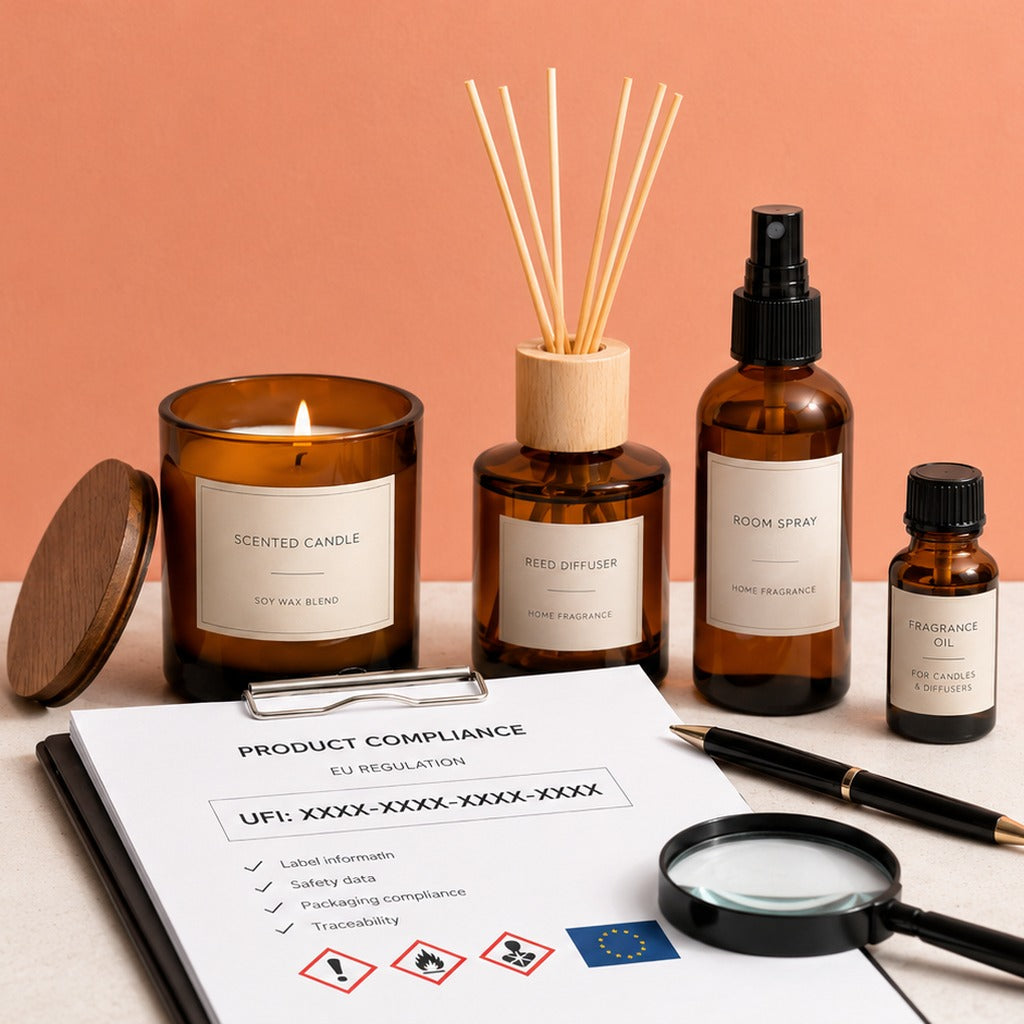
1. What a room spray actually is (and what it is not)
In formal terms, a room spray is a non-skin fragrance product designed to be sprayed into the air or onto selected textiles and surfaces. Regulatory frameworks usually place room sprays in IFRA Category 9 (air fresheners and some fabric sprays), which determines the maximum allowable fragrance percentage for each specific fragrance.
A basic room spray has four functional components:
1. Fragrance phase
-
Fragrance oils, essential oils, or blends.
2. Carrier/base
- Alcohol (ethanol/perfumer’s alcohol),
- Solvent base (e.g. Augeo® Clean Multi or commercial “room spray base”),
- Water (with solubiliser).
3. Solubiliser/emulsifier (if needed)
- Commonly Polysorbate-20 or similar.
4. Optional functional extras
- Preservative (if water is present),
- pH adjuster,
- Humectant or other actives (for linen/pillow mists).
2. Choosing your overall formulation strategy
There are three main strategies that serious makers use:
1. Alcohol-based sprays (classic fine mist, fast evaporation)
- Carrier: high-proof ethanol or commercial alcohol room-spray base.
- Pros: clear solutions, quick-drying, strong initial impact, low residue.
- Cons: flammable, more regulatory constraints for transport and storage.
2. Solvent-base sprays (e.g. eco-solvent like Augeo Clean Multi)
- Carrier: specialty solvents optimised for home fragrance.
- Pros: clear, non-flammable (for some bases), very good solubility, strong scent, longer linger.
- Cons: can feel “oilier” on some surfaces, not always suitable for skin.
3. Water-based sprays with solubiliser (often for linens & fabric)
- Carrier: demineralised water + solubiliser (e.g. Polysorbate-20) + a small alcohol fraction.
- Pros: less flammable, softer profile for textiles, easier perception as “natural”.
- Cons: needs preservative, can be hazy/milky, may leave a slight residue if overused.
When you design a formula, decide first:
- Target: air only, air + textiles, or multi-surface.
- Brand position: eco/solvent-free, alcohol-style fine fragrance, or high-impact industrial.
- Legal constraints: IFRA limits, CLP/GHS labeling (EU/UK), VOC regulations (e.g. CARB in the US).
3. Fragrance load: how much fragrance oil should you use?
3.1 Typical ranges
Most professional suppliers suggest 3–10% fragrance oil in room sprays:
- 3–5% for subtle mists, delicate or strong oils.
- 5–8% for general room sprays.
- 8–10% for stronger impact, provided the IFRA limit for that fragrance allows it.
For certain solvent bases like Augeo® Clean Multi, some diffuser formulas use up to 15–25% fragrance, mainly for reed diffusers.
For room sprays, you usually don’t need to go that high; 3–10% is normally plenty.
3.2 Always check IFRA limits
Each fragrance oil comes with an IFRA certificate listing the maximum allowed percentage for each category (Category 9 = air fresheners, some fabric sprays). Professional guides strongly recommend respecting these limits when choosing your load.
If your target is 8% but IFRA Category 9 max is 3%, you must stay at or below 3%.
4. Bases: ethanol, solvent bases, and water systems
4.1 Alcohol bases (ethanol / perfumer’s alcohol)
Several pro recipes for room/linen sprays use a small % of alcohol + water + solubiliser, but in a pure alcohol system you can keep it very simple: alcohol + fragrance.
Why use it:
- Very fast evaporation → crisp, non-sticky finish.
- Generally clear if your fragrance is compatible.
- Classic perfume-like experience.
Watchpoints:
- Flammability → impacts shipping and labeling.
- Some customers dislike the ethanol odour on spray (usually flashes off in seconds).
Practical starter formula (100 g / 100 ml batches)
Target: Air room spray (no direct fabric use on delicate textiles).
Formula (100 g):
- 5% fragrance oil (5 g)
- 95% perfumer’s alcohol (95 g)
Steps:
- Weigh fragrance oil into a beaker.
- Add perfumer’s alcohol, stir until fully clear.
- Let rest 24–48 h (or more) to allow micro-bubbles to escape and the scent to “marry”.
- Filter if needed, then bottle in fine-mist atomisers.
Watchpoints:
- For stronger scent, go up to 8–10% fragrance if allowed by IFRA Category 9 and flashpoint considerations.
- For a softer linen spray, reduce to 3–4%, and test on fabrics.
4.2 Eco-solvent bases (Augeo® and commercial room spray bases)
Augeo Clean Multi is a bio-based solvent widely used in reed diffusers and room/linen sprays. It has:
- Very good solubilising power for fragrance oils.
- Low odour profile.
- Non-flammable classification in many markets.
- VOC-compliant status in several jurisdictions (e.g. CARB-compatible scent loading).
For room sprays, 3–10% fragrance in an Augeo-type base is usually sufficient. Many “eco room spray bases” from candle suppliers are built on similar logic: bio solvent + modifiers, designed for 3–10% fragrance.
Why use it:
- Excellent clarity and stability with fragrance.
- Often non-hazardous or low-hazard, sometimes not requiring CLP label at low loads.
- Good long-lasting scent and slow, even evaporation.
Watchpoints:
- Feels slightly less “dry” than pure alcohol on textiles.
- Still requires CLP/IFRA assessment at higher fragrance loads.
Practical starter formula (100 g / 100 ml batches)
Target: Room & light textile spray with non-flammable base.
Formula (100 g):
- 7% fragrance oil (7 g)
- 93% eco room-spray base or Augeo Clean Multi (93 g)
Steps:
- Weigh fragrance oil.
- Add to the eco base (Augeo or similar), stir slowly until the blend goes homogeneous and clear.
- Rest 24–72 h to check for separation or haziness.
- Bottle in trigger sprays or fine misters.
Watchpoints:
- You can scale fragrance between 3-10%; for home fragrance, higher loads (15–20%) are typical for diffusers, not necessary for sprays.
- Always re-check CLP classification when you change the percentage.
4.3 Water-based systems with solubiliser
Water-based sprays combine:
- Water (usually demineralised or distilled).
- Fragrance oil.
- Solubiliser/emulsifier (often Polysorbate-20).
- Optional preservative (e.g. sodium benzoate) when water is present.
Pros: Lower alcohol content.
Softer, textile-friendly positioning (depending on fragrance).
Watchpoints: Some perfumers note that large water fractions increase solubility problems; many fragrance ingredients are not water-soluble, and solubiliser residues can feelsticky or slipperyon surfaces and floors.
Always test on fabrics to avoid staining or residue.
Practical starter formula (100 g / 100 ml batches)
Target: Linen & room mist with reduced alcohol. Many suppliers recommend 1:2:4 Preservative: Polysorbate-20: Fragrance oil by weight to obtain a clear or nearly clear solution.
First, you need to decide what percentage of fragrance oil you want to add — usually between 3–10%. Then, determine the total weight of your system, which is usually equal to the volume of your bottle.
- Polysorbate-20 = FO,g x 0.5
- Preservative = FO,g x 0.5
- Water = 100 - (FO,g + Polysorbate-20,g + Preservative,g)
Formula (100 g):
- 4g fragrance oil (4%)
- 2g Polysorbate-20 (2%)
- 1g preservative (1%)
- 93g distilled water (93%)
Steps:
- Mix fragrance oil and Polysorbate-20; stir until the blend becomes uniform and as clear as possible.
- Add preservative according to supplier instructions.
- Add water slowly while stirring.
Watchpoints:
- Expect a slightly milky appearance; this is normal for many Polysorbate systems and is often hidden by opaque or frosted bottles.
- Always perform stability tests and a fabric test. (The test should be performed on white fabric)
5. Working with fragrance oils: compatibility, strength, and safety
5.1 Checking IFRA and usage rates
For each fragrance:
- Get the IFRA certificate from your supplier.
- Find the limit for Category 9 (room sprays, air fresheners).
- Make sure your chosen % is at or below that limit.
5.2 Solubility and clarity
- Some fragrance oils contain highly polar ingredients and emulsifiers → easier to solubilise.
- Others are rich in heavy base notes (e.g. resins, ouds, patchouli) → harder to solubilise, more likely to haze.
If you see cloudiness / separation:
In alcohol:
- Reduce water content (if any),
- Increase alcohol strength,
- Slightly reduce fragrance load.
In water + Polysorbate:
- Increase Polysorbate,
- Reduce fragrance load,
- Try a different solubiliser or fragrance.
In eco-solvent bases:
- Check supplier’s recommended maximum load,
- Try a different eco-base or fragrance family.
6. Process and testing: getting reliable results
6.1 Mixing order and technique
Phase A: fragrance + solubiliser (if used)
- Mix until clear and uniform.
Phase B: solvent/base
- Add slowly while stirring gently to avoid excessive foaming.
Phase C: water (if applicable)
- Add in several portions, mixing thoroughly.
Phase D: additives/preservative
- Add at the end, according to supplier guidelines.
What else is important? Slow mixing, resting time and small pilot batches before scaling up.
6.2 Stability checks
Before you consider a formula “final”, run basic tests:
- 24–72 h clarity check at room temperature.
-
Freeze–thaw test:
24 h in the fridge/freezer, then back to room temperature. Observe for separation, sediment, or permanent haziness. - Shake test: Shake vigorously, leave to stand. Persistent foam after several hours can annoy end-users.
6.3 Performance tests
Test in a realistic room size:
1–2 sprays at standard distance (30–50 cm from air or textiles).
What is important:
- Initial impact (top notes),
- Development after 5, 15, 30 minutes,
- Residual scent after 2–4 hours.
On textiles:
- Spray from a distance (30–50 cm) on white cotton swatch.
Check for:
- Staining/discoloration,
- Oily marks,
- Residue or stickiness after drying.
7. Safety, CLP/IFRA and VOC considerations
7.1 CLP/GHS and labeling (EU/UK)
For the EU/UK, if your product is classified as hazardous (e.g. due to fragrance hazards), you may need a CLP label. For example, guides for working with Augeo + fragrance (up to 25%) show how hazard classifications change with load and provide label templates.
Some commercial room-spray bases and linen bases are formulated to be non-hazardous at typical fragrance loads, meaning they may not require a CLP label by themselves, but you must always reassess after adding fragrance.
7.2 IFRA compliance
Room sprays typically fall under IFRA Category 9:
- The IFRA limit for each fragrance (Category 9) is the absolute ceiling for your fragrance % in the formula.
- If you sell internationally, keep IFRA-compliant documentation (Formula, IFRA certs, SDS) in your batch files.
7.3 VOC and flammability
Alcohol-based sprays are flammable and subject to transport rules (ADR, IATA). Eco-solvent bases such as Augeo Clean Multi are designed as low VOC, non-flammable options that comply with VOC regulations (e.g. CARB) while still allowing relatively high fragrance loads in air-care products.
8. Troubleshooting: common room spray problems
8.1 Cloudy or milky appearance
Possible causes:
- Insufficient solubiliser for the fragrance load.
- Incompatible fragrance components (especially resins/base notes).
- Too much water in a system with lipophilic ingredients.
Fix:
- Increase solubiliser gradually (e.g. from 4% to 5–6%).
- Reduce fragrance % slightly (e.g. from 5% to 3–4%).
- Switch to a different base (e.g. eco-solvent) or different fragrance.
8.2 Separation / “oil layer” on top
Possible causes:
- Fragrance not fully solubilised.
- Incorrect mixing order or insufficient mixing time.
Fix:
- Pre-mix fragrance + solubiliser thoroughly before adding water or main base.
- Allow a longer rest period and retest.
- If separation persists after 48–72 h, adjust ratios or change solubiliser/base.
8.3 Sticky floor or residue
Perfumers note that water-heavy sprays with non-volatile solubilisers can leave sticky/slippery residues on surfaces, as the solubiliser stays behind when the water evaporates.
Fix:
- Reduce total solubiliser.
- Use more volatile carriers (ethanol or eco-solvent).
- Adjust instructions (“spray into the air, not directly onto floors”).
8.4 Weak scent
Possible causes:
- Fragrance % too low.
- Fragrance itself has low diffusion in air.
- Overly “heavy” base, low evaporation.
Fix:
- Increase fragrance load within IFRA limits (e.g. from 3% → 5% → 7%).
- Try a different base (more volatile).
- Switch to more diffusive fragrance families (citrus, aromatics, aldehydic notes).
9. Example development workflow for a new room spray
Define the brief
- Target: “Citrus–herbal kitchen spray, strong but not overpowering, alcohol-based.”
Check IFRA Category 9 limit for the chosen fragrance
- Suppose IFRA max is 8%.
Choose base strategy
- Perfumer’s alcohol, 5–7% fragrance test range.
Design initial trials (small batches, 50–100 g)
- Trial A: 5% fragrance, 95% alcohol.
- Trial B: 7% fragrance, 93% alcohol.
Mix, rest 48 h, evaluate
- Check clarity, no separation, no sediment.
- Do performance tests in a real room.
Adjust
- If Trial A is too weak and Trial B is perfect, you keep 7%.
- If both are harsh, drop to 4–5% and/or adjust fragrance choice (softer profile).
Document formula + batch data
- Keep record: weights, temperatures, mixing steps, observations.
Prepare CLP/label and IFRA documentation
- Calculate hazards for the chosen % using supplier data and any CLP calculators for your base system.