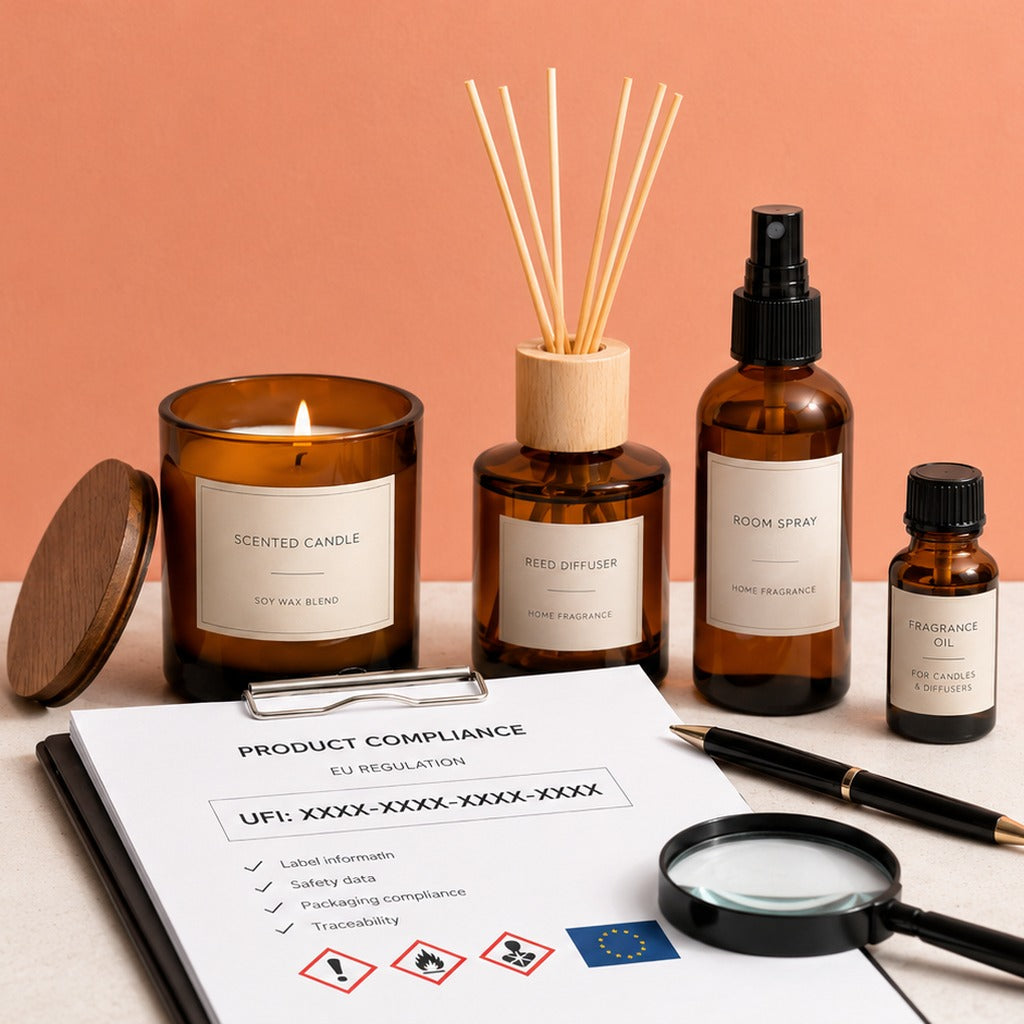
If you make scented candles, room sprays, reed diffusers, wax melts or other fragrance-based products in the EU, you have probably seen the term UFI appear on safety data sheets, CLP labels or supplier documents. It looks like a small code. In practice, it can decide whether your finished product needs a Poison Centre Notification, a specific label update, and more careful formula management before you place it on the market. This guide explains what a UFI code is, when it is needed, and how to think about it when working with fragrance oils.
What is a UFI code?
UFI stands for Unique Formula Identifier. It is a 16-character alphanumeric code used in the EU to connect a hazardous mixture placed on the market with the information submitted to poison centres. In an emergency, the UFI helps poison centres identify the product and its composition more quickly. [1] A UFI usually looks like this:
UFI: XXXX-XXXX-XXXX-XXXXThe UFI is not just a decorative label element. It must match the product information submitted through the Poison Centre Notification process.
UFI and PCN: not the same thing
The UFI is the code. The PCN, or Poison Centre Notification, is the submission behind that code.
| Term | What it means |
|---|---|
| UFI | The visible code on the label or, in some cases, in the SDS |
| PCN | The notification submitted to poison centres |
| CLP | The EU regulation that defines classification, labelling and packaging rules |
| SDS | The safety data sheet used to communicate safety and handling information |
You do not simply generate a UFI and stop there. If your product is in scope, the UFI must be connected to a valid PCN submission for the relevant market.
When does a home fragrance product need a UFI?
A finished product generally needs a UFI and PCN when it is:
- a mixture placed on the EU market;
- classified as hazardous under CLP for human health hazards or physical hazards;
- sold for consumer, professional or industrial use.
This can apply to many fragrance-based products, including room sprays, reed diffusers, scented candles, wax melts, fragrance oils sold as raw materials, some solid wax fragrance products and other scented mixtures, depending on their final classification. The legal trigger is not the product category alone. It is the CLP classification of the finished mixture. Annex VIII to the CLP Regulation requires submissions for mixtures classified as hazardous on the basis of health or physical effects before they are placed on the market in the relevant Member State. [2,3]
When is a UFI not expected?
A UFI is usually not required when the finished product is not classified as hazardous for human health or physical hazards under CLP. It is also not normally required only because a mixture is classified for environmental hazards. The key PCN trigger is health and physical hazard classification, not environmental classification alone. [4] This is where many makers get confused. A product can be:
- not subject to PCN/UFI;
- still require some CLP label wording;
- still require EUH208 allergen wording;
- still require environmental labelling;
- still need correct SDS or supplier documentation for B2B use.
In other words: no UFI does not automatically mean no CLP work.
Why fragrance load matters
Fragrance oils are complex mixtures. Many contain naturally occurring or synthetic components that may be classified as skin sensitizers, irritants, flammable substances or environmentally hazardous substances. When you add a fragrance oil to a base, the final classification depends on the final concentration of those components. The simple calculation is:
final concentration of a component = fragrance load x component concentration in the fragrance oil / 100Example:
A fragrance oil contains 12% of a Skin Sens. 1B component.
You use the fragrance oil at 3% in a room spray.
Final concentration:
3 x 12 / 100 = 0.36%
That final concentration is then assessed against CLP classification rules. This is why there is no universal UFI-free percentage for all fragrance oils. One fragrance oil may stay below the relevant CLP thresholds at 3%. Another may trigger classification at the same dosage.
Why room sprays are different from candles
A candle often uses a fragrance load around 6-12%. A room spray may use 1-3%. A pillow spray may use even less. A reed diffuser may use much more fragrance oil, often alongside a solvent or diffuser base. That means the same fragrance oil can behave very differently across product types.
| Product type | Typical fragrance load logic | UFI risk |
|---|---|---|
| Room spray | Often low fragrance load, but base may be flammable | Depends on fragrance and solvent system |
| Candle | Higher fragrance load, often 6-12% | Sensitisation thresholds may be reached more easily |
| Reed diffuser | Often high fragrance load | UFI more likely |
| Wax melt | Similar to candles, depending on dosage | Depends on final CLP classification |
| Soap | Lower fragrance load, different regulatory context depending on product | Needs separate assessment |
| Solid wax perfume / wax fragrance product | Dose depends on use concept and base | Needs formula-specific review |
This is why UFI-friendly fragrance selection is most useful when it is linked to a specific application and use rate, not used as a general claim.
Can I use my supplier's UFI?
Not usually for your finished product. If you buy a fragrance oil, that fragrance oil may have its own UFI as a supplied mixture. But when you blend it into your own finished product, you may create a new mixture with a different composition and classification. Your finished product may need its own CLP assessment, its own PCN submission, and its own UFI. There is a related concept called MiM, or mixture in mixture. This is relevant when one mixture, such as a fragrance oil, is used as a component in another mixture. Annex VIII allows a MiM to be identified by product identifier and UFI when the full composition is not available to the submitter. [3,7] Useful, yes. A shortcut around final product compliance, no.
What information is needed for a PCN?
A PCN is not just a code request. It normally requires structured product and formula information. This includes, among other things:
- product identifier and trade name;
- submitter details;
- CLP classification for health and physical hazards;
- label information;
- toxicological information;
- mixture components and concentration information;
- product category and intended use;
- packaging type and size.
Tukes, the Finnish Safety and Chemicals Agency, summarises the required notification content as product identifier, submitter details, classification, label information, toxicity information and mixture component information. [5] For small brands, this means formula discipline matters. If every batch uses a slightly different fragrance load, base, colourant or additive, compliance becomes harder to manage.
Do rules differ between EU countries?
The CLP framework is EU-wide. The basic logic for when a hazardous mixture needs PCN/UFI is harmonised. However, practical details can still vary by Member State:
- the notification must cover every Member State where the mixture is placed on the market;
- language requirements may differ;
- national appointed bodies may have specific processes;
- some countries may have additional administrative requirements or fees;
- SDS and label language must be suitable for the market.
Annex VIII states that the submission must be made in the official language of the Member State where the mixture is placed on the market, unless that Member State provides otherwise. Tukes also notes that the company responsible for notification must make sure the information is submitted to all Member States where the mixture is placed on the market. [3,5] So the classification logic is harmonised, but the rollout still needs market-by-market attention.
What changed in 2025?
The transitional period for older national notifications has effectively ended. Consumer and professional mixtures have been under harmonised PCN requirements since 2021. Industrial-use mixtures followed from 2024. Previously notified mixtures could benefit from transitional arrangements until 1 January 2025, unless changes were made earlier. [5] For makers and small brands, the practical message is simple: Do not rely on old national notification habits. Work with the harmonised PCN/UFI system.
The UFI is created using ECHA tools, and Annex VIII requires it to be printed or affixed on the label of a hazardous mixture, clearly visible, legible and indelibly marked. For certain industrial-use or unpackaged mixtures, it may be indicated in the safety data sheet instead. [3,6]
Common mistakes with UFI and fragrance oils
1. Assuming every fragrance oil needs the same percentage limit
It does not. The relevant percentage depends on the composition of the fragrance oil and the final product formula.
2. Thinking natural means no CLP issue
Natural fragrance components can still be allergens, sensitizers, irritants or environmentally hazardous. CLP does not disappear because an ingredient sounds botanical.
3. Using the supplier's UFI for the finished product
The supplier's UFI may identify the fragrance oil. Your finished room spray, candle or diffuser is a different mixture.
4. Forgetting the base
A fragrance oil may be suitable at a certain percentage, but the base can still trigger a hazard. Alcohol-based sprays are the obvious example because physical hazards such as flammability may apply.
5. Treating no UFI expected as no label needed
A product may avoid PCN/UFI and still need correct CLP wording, EUH208, environmental labelling or B2B documentation.
A practical workflow for makers
Before selling a fragrance-based product in the EU, work through this checklist.
1. Define the finished product
Do not assess the fragrance oil in isolation. Define the actual product:
Room spray with 2% fragrance oil in base Xor:
Container candle with 8% fragrance oil in wax Y2. Fix the exact formula
Record:
- fragrance oil percentage;
- base;
- wax, solvent or carrier;
- dyes and additives;
- intended use;
- packaging size;
- market countries.
3. Check the SDS and IFRA documentation
Use supplier documentation as input, not as a substitute for final classification.
4. Classify the finished mixture
The final product classification determines whether PCN/UFI is required.
5. Prepare the label
If the product is hazardous, the label may need:
- hazard pictograms;
- signal word;
- hazard statements;
- precautionary statements;
- allergen wording where relevant;
- UFI;
- supplier details;
- nominal quantity and other required label elements.
6. Submit PCN where required
If the product is in scope, submit the PCN before placing it on the market.
7. Control formula changes
Changes in composition, classification, toxicological information or product identifiers may trigger a PCN update or a new UFI. Annex VIII requires updates without undue delay when relevant conditions are met. [3]
What does UFI-friendly fragrance oil mean?
At AROMA + WAX, we use this idea carefully. A fragrance oil should not be described as universally UFI-free. That would be too broad. A more accurate approach is:
No PCN/UFI expected up to X% in a specific application,
based on CLP calculation for the stated base and use rate.
For example:
No PCN/UFI expected up to 2% in room sprays*or:
No PCN/UFI expected up to 3% in liquid soap*The asterisk matters. A proper footnote should explain:
*Based on CLP calculation for the stated application and use rate. Final product classification remains the responsibility of the maker placing the product on the market. EUH208 and/or environmental labelling may still apply.This gives makers useful information without pretending that one fragrance oil has the same regulatory result in every possible formula.
Final thought
UFI is not there to make product development more annoying, although it can certainly feel that way on a busy launch week. Its purpose is practical: if someone is exposed to a hazardous mixture, poison centres need accurate product information quickly. For makers, the best way to handle UFI is not panic. It is structure. Use fixed formulas. Keep supplier documents organised. Check the final CLP classification. Treat fragrance load as part of compliance, not just scent performance. And when choosing fragrance oils for lower-dose products, shortlist options that make the regulatory path cleaner from the start. Less guesswork. Better labels. Fewer surprises before launch.
Working on low-dose fragrance products?
Explore UFI-friendly fragrance oils for room sprays, soaps, solid wax perfumes and other carefully dosed applications. Each oil is sorted by calculated use rate, so you can shortlist options with less CLP guesswork.
Important note. This guide is for general information only and does not replace a product-specific CLP assessment or regulatory advice. Final classification, labelling and notification remain the responsibility of the company placing the finished product on the market.
Sources consulted
- European Commission - Poison centres
- ECHA - Know your obligations
- EUR-Lex - Commission Regulation (EU) 2017/542 / CLP Annex VIII
- ECHA - Assess exceptions to standard requirements
- Tukes - Submitting information on hazardous mixtures to poison centres
- ECHA - Why the UFI matters for everybody
- ECHA - Get organised in your supply chain